Additional Programs
Music Theory
Launching soon.
Join the early-access list and be the first to know when enrollments open. We tailor our teaching to you, whether you're a beginner, intermediate, advanced, or a college-prep / portfolio student.
Music Theory
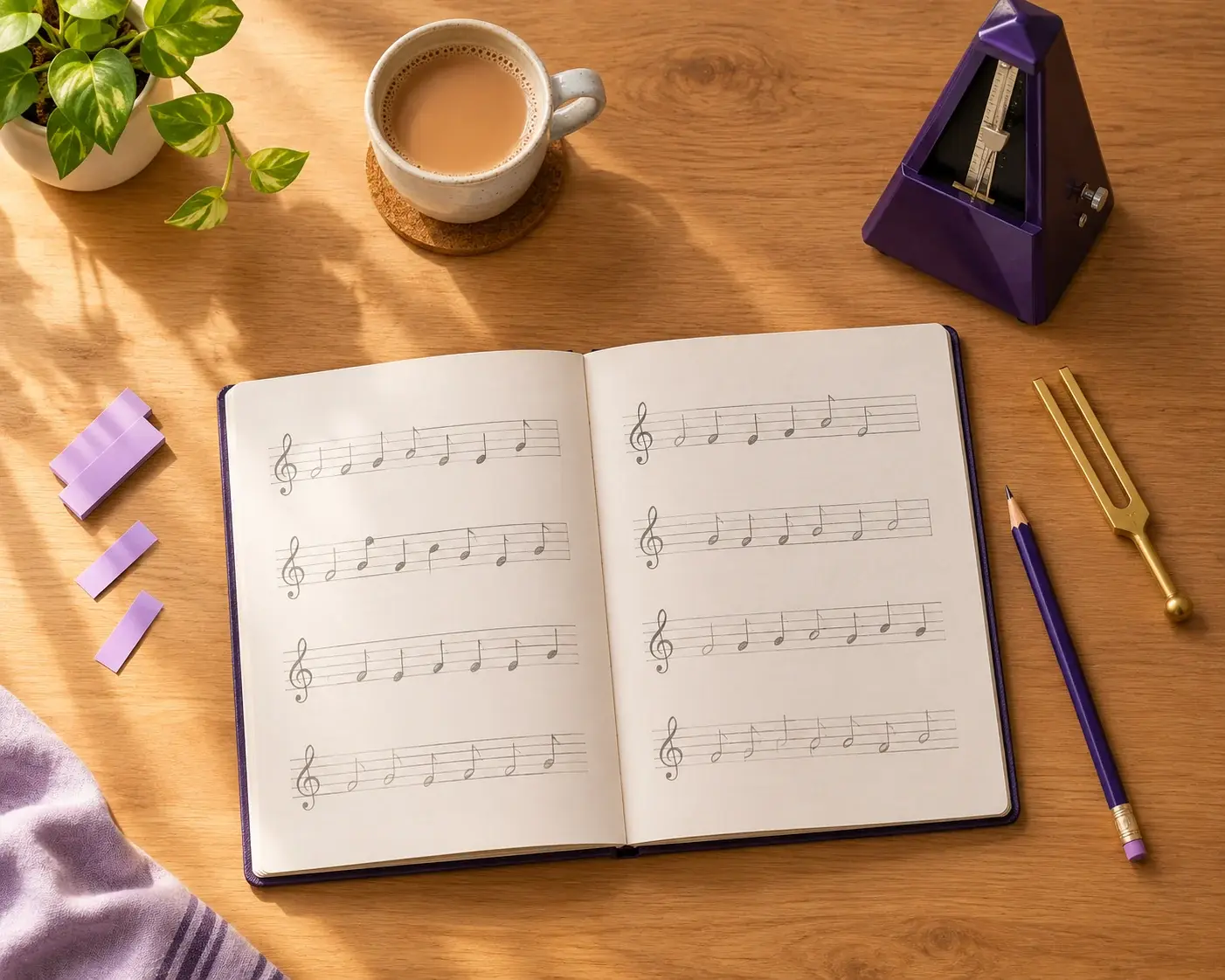
Learn to read, write and understand music, from notation and rhythm to scales, intervals and harmony. Built to take you toward Grade 5 theory, the qualification needed before the higher practical grades on any instrument.
Learning Roadmap
From your first chord to stage-ready performance, at a pace that fits you.
The usual route · Music Theory
Beginner
Reading notes and rhythms, and your first theory grade.
Elementary
Scales, keys and the basics of chords.
Intermediate
How chords fit together, and Grade 5, which opens the higher exams on any instrument.
Advanced
Harmony, writing your own music and the history of Western music.
What Music Theory trains
Brain benefitsReading music.
Read notes and rhythms fluently, on any instrument.
Knowing why.
Understand why chords and scales work the way they do.
Hearing structure.
Hear how the music you already know is put together.
This Course Pairs Well With…
Round out your sound with a complementary instrument or voice

History of Music Theory
Music theory's earliest roots go back to ancient Greece, where Pythagoras is credited with discovering that pleasing musical intervals correspond to simple mathematical ratios between string lengths. Medieval church musicians built on that with the modal system used in chant, and by the Baroque era, the age of Bach, the harmony and key system that still underpins most Western music today had been largely codified.
Music to hear theory at work
Four chords that power a whole song. A good first listen.